




By the end of the first weekend of March Madness, most brackets are already broken.
Fans compare seeds, read predictions, and scan team records. Then a few early upsets change everything.
That unpredictability is part of what makes the tournament fun. But the outcomes are not completely random. Certain team characteristics and matchup dynamics consistently influence how games unfold.
If you want to build a stronger bracket, it helps to approach the tournament the same way analysts approach complex problems. Start by identifying the factors that influence results. Then use data to see which ones stand out.
Two simple tools can help structure that thinking:
- a fishbone diagram to organize the factors that influence tournament games
- a statistical outlier test to identify unusual teams worth examining more closely
Key Factors That Influence March Madness Bracket Picks
Before jumping to analysis, it helps to organize the factors that influence tournament outcomes.
A fishbone diagram, located in Minitab Brainstorm, is a simple way to do that. It allows you to map the potential causes of an outcome and group them into categories.
In this case, the outcome we are examining is straightforward:
Bracket picks fail because of unexpected tournament outcomes.
We started by outlining four common categories that influence tournament games: team strength, matchup fit, momentum and health, and seeding versus reality.
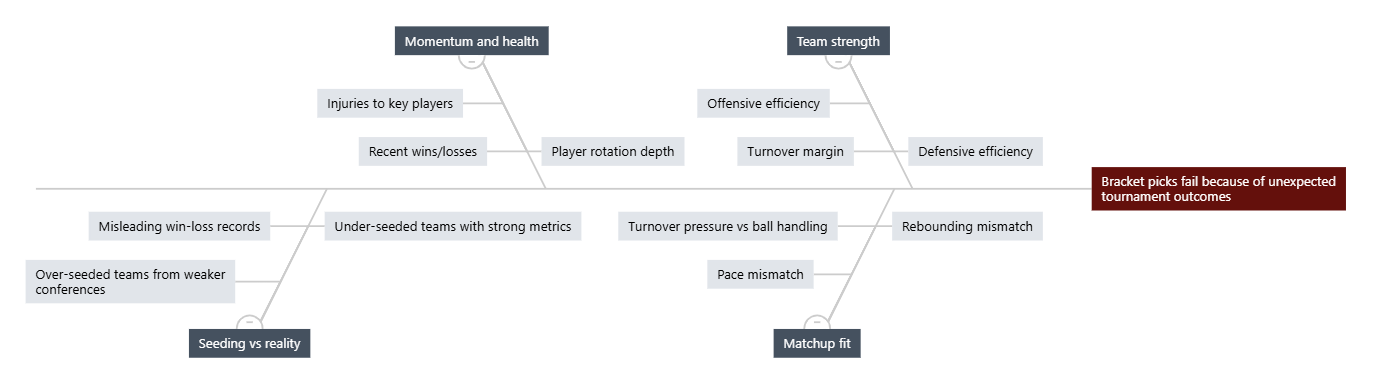
Each branch represents a group of factors that can affect game results.
- Team strength: offensive efficiency, defensive efficiency, turnover margin
- Matchup fit: pace mismatches, turnover pressure versus ball handling, rebounding advantages
- Momentum and health: injuries to key players, recent performance trends, rotation depth
- Seeding versus reality: misleading win loss records, under seeded teams with strong metrics, over seeded teams from weaker conferences
This type of diagram helps organize the variables worth considering when evaluating potential upsets.
Did you know Minitab helped LG Chem save $73 million?

How AI Expands Your Bracket Analysis
Once the initial structure was built, we used Minitab’s AI Quick Generate feature to expand the diagram and surface additional factors.
Quick Generate analyzes the structure of the diagram and suggests related variables that might influence the outcome. This can help identify blind spots or factors that might otherwise be overlooked.
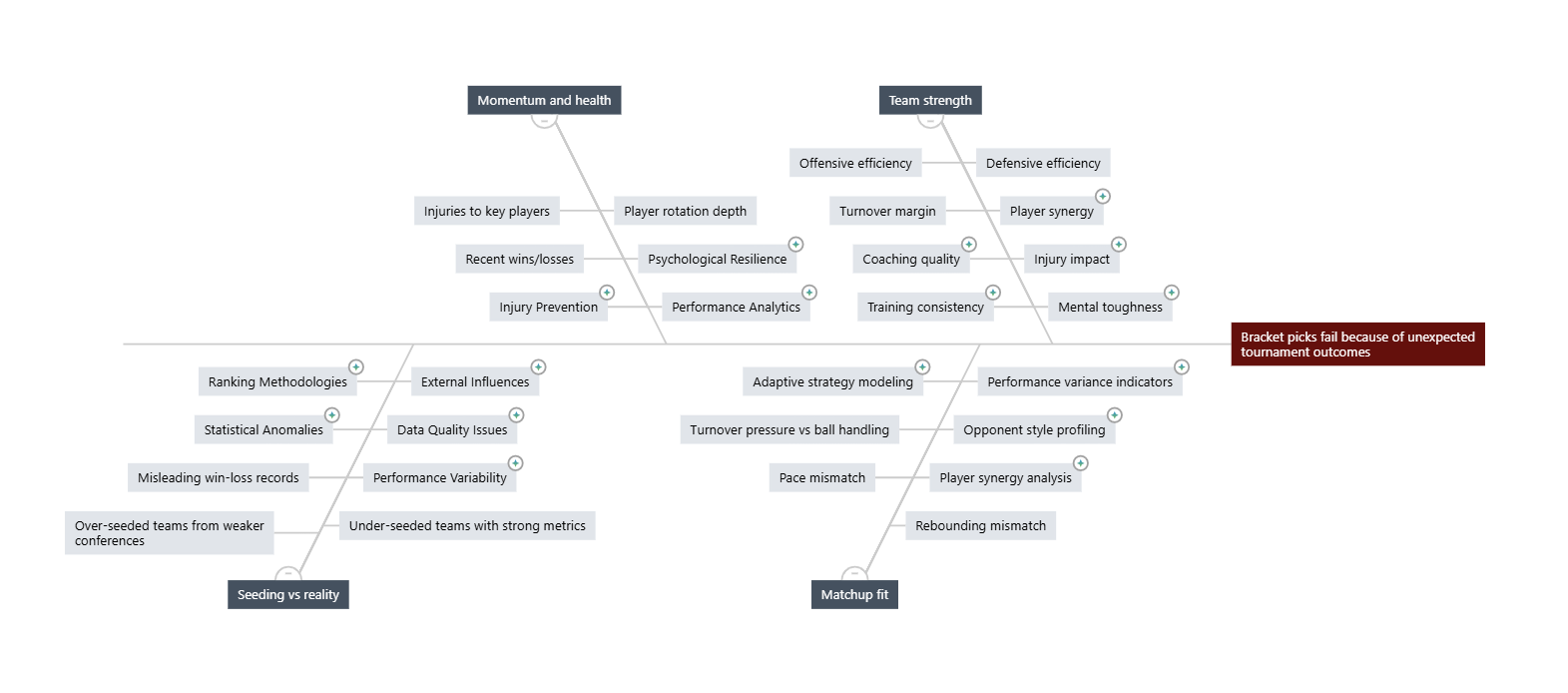 The AI-generated expansion surfaced additional considerations such as:
- Coaching quality and training consistency
- Opponent style profiling and adaptive strategy
- Performance variability indicators
- Player synergy and mental toughness
- Data quality or ranking methodology differences
These additions do not replace the core categories. Instead, they broaden the analysis and highlight additional variables that may influence tournament outcomes.
How to Identify Cinderella Teams with Statistics
Once you have identified possible factors, the next step is testing whether any teams stand out.
One variable that often influences close games is turnover rate.
Teams that protect the ball well tend to produce more stable offensive possessions. In a single elimination tournament, where a few possessions can decide a game, that stability is critical.
To explore this idea, we ran an outlier test on a dataset of tournament teams using turnover rate. The goal was to determine whether any teams had turnover rates that were unusually low compared with the rest of the field.
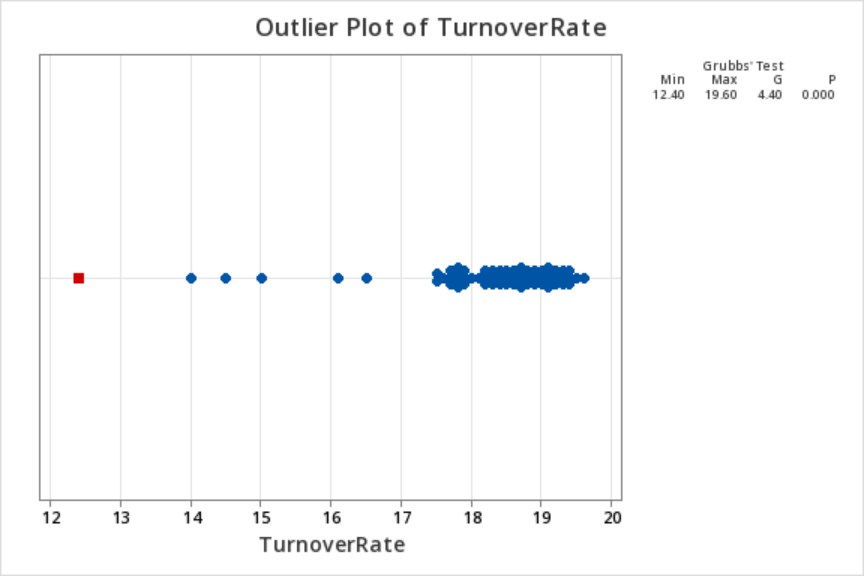
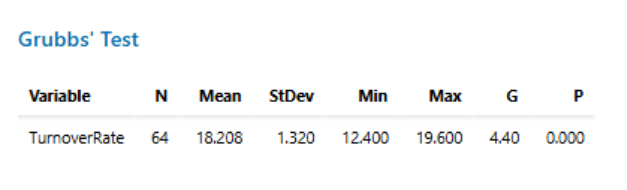
The analysis flagged one team that had a turnover rate of 12.4 percent, noticeably lower than the rest of the dataset. The test statistic was G = 4.40 with a p value of 0.000, indicating that this observation behaves differently from the rest of the sample. 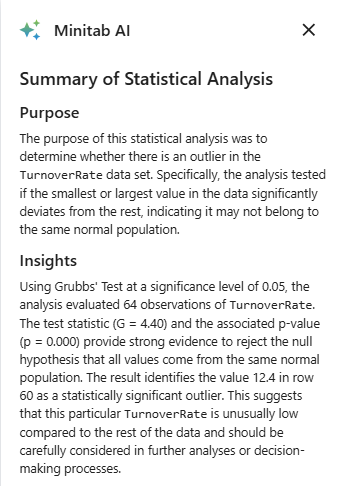
In practical terms, this team protects the ball at a level that is uncommon among tournament teams. When evaluating lower seeded teams, unusual statistical strengths like this can be worth considering.
Turnover rate alone will not determine how far a team advances. However, identifying teams with metrics that sit far outside the typical range can highlight programs that may outperform expectations. You might also consider three-point percentage and defensive efficiency.
Minitab’s AI generated summary helps interpret results like this by explaining the statistical output in plain language. In this case, the summary highlights that the lowest turnover rate in the dataset is statistically significant and behaves differently from the rest of the field.
In practical terms, this team protects the ball at a level that is uncommon among tournament teams. When evaluating lower seeded teams, unusual statistical strengths like this can be worth considering.
How Data Can Help You Pick Better March Madness Upsets
March Madness will always include surprises. A few possessions, a shooting streak, or foul trouble can change a game.
Looking at underlying metrics can still reveal patterns that casual observation misses. Teams with unusually strong rebounding, elite turnover control, or efficiency metrics that outperform their seed sometimes emerge as tournament surprises.
Approaching bracket predictions with structured analysis will not produce a perfect bracket. It does create a clearer way to evaluate teams and identify statistical signals that may point to potential upsets.
Apply these same techniques to your most important decisions. Start your free trial of Minitab Solution Center today.
