---
title: Improve Manufacturing ROI with Real-Time Visibility
description: See how one manufacturer used real-time data and standardized workflows to improve visibility, reduce downtime, and make faster decisions on the shop floor.
image: https://blog.minitab.com/hubfs/hydro1.png
---
English
- [English](https://blog.minitab.com/en/?hsLang=en)
- [Français](https://blog.minitab.com/fr/?hsLang=en)
- [Deutsch](https://blog.minitab.com/de/?hsLang=en)
- [Português](https://blog.minitab.com/pt/?hsLang=en)
- [Español](https://blog.minitab.com/es/?hsLang=en)
- [日本語](https://blog.minitab.com/ja/?hsLang=en)
- [한국어](https://blog.minitab.com/ko/?hsLang=en)
- [中文(简体)](https://blog.minitab.com/zh/?hsLang=en)
- [ Partners](https://www.minitab.com/en-us/company/partners/)
- [ Contact](https://www.minitab.com/en-us/company/contact-us/)
- [ Talk to Minitab](https://www.minitab.com/en-us/talk-to-minitab/)
- [ My Account](https://licensing.minitab.com/account/manage)
[](https://www.minitab.com/en-us/)
- Products
Back
[Products](https://www.minitab.com/en-us/products/)
[All Products](https://www.minitab.com/en-us/products/)
- [Minitab Solution Center](https://www.minitab.com/en-us/products/minitab-solution-center/)
- [Minitab Statistical Software](https://www.minitab.com/en-us/products/minitab/)
- [Minitab Connect](https://www.minitab.com/en-us/products/connect/)
- [Minitab Model Ops](https://www.minitab.com/en-us/products/model-ops/)
- [Minitab Education Hub](https://www.minitab.com/en-us/products/education-hub/)
- [Minitab Engage](https://www.minitab.com/en-us/products/engage/)
- [Minitab Workspace](https://www.minitab.com/en-us/products/workspace/)
- [Real-Time SPC](https://www.minitab.com/en-us/products/real-time-spc/)
- [Prolink Data Collection & SPC](https://www.minitab.com/en-us/products/prolink)
- [Simul8 Discrete Event Simulation](https://info.minitab.com/en/new-to-simul8?hsLang=en)
- [SPM](https://www.minitab.com/en-us/products/spm/)
- Solutions
Back
[Solutions](https://www.minitab.com/en-us/solutions/)
[All Solutions](https://www.minitab.com/en-us/solutions/)
- [Analytics](https://www.minitab.com/en-us/solutions/analytics/)
- [Statistics & Predictive Analytics](https://www.minitab.com/en-us/solutions/analytics/statistical-analysis-predictive-analytics/)
- [Data Science & Machine Learning](https://www.minitab.com/en-us/solutions/analytics/data-science-machine-learning/)
- [Business Analytics & Intelligence](https://www.minitab.com/en-us/solutions/analytics/business-analytics-intelligence/)
- [Statistical Process Control](https://www.minitab.com/en-us/solutions/analytics/statistical-process-control/)
- [Quality Analytics](https://www.minitab.com/en-us/solutions/analytics/quality-analytics/)
- [Live Analytics](https://www.minitab.com/en-us/solutions/analytics/live-analytics/)
- [Reliability & Life Data Analysis](https://www.minitab.com/en-us/solutions/analytics/reliability/)
- [Discrete Event Simulation](https://info.minitab.com/en/new-to-simul8?hsLang=en)
- [Process Mining](https://info.minitab.com/en/new-to-simul8?hsLang=en)
- [Key Capabilities](https://www.minitab.com/en-us/solutions/key-capabilities/)
- [Continuous Improvement](https://www.minitab.com/en-us/solutions/key-capabilities/continuous-improvement/)
- [Data Integration & Data Prep](https://www.minitab.com/en-us/solutions/key-capabilities/data-integration-data-prep/)
- [Diagramming & Mind Mapping](https://www.minitab.com/en-us/solutions/key-capabilities/diagramming-mind-mapping/)
- [Digital Twins](https://info.minitab.com/en/new-to-simul8?hsLang=en)
- [Model Deployment & ML Ops](https://www.minitab.com/en-us/solutions/key-capabilities/model-deployment-ml-ops/)
- [Innovation & Project Management](https://www.minitab.com/en-us/solutions/key-capabilities/innovation-project-management/)
- [Process Excellence: Detect, Correct & Prevent](https://www.minitab.com/en-us/solutions/key-capabilities/process-excellence/)
- [Featured Industries](https://www.minitab.com/en-us/solutions/industry/)
- [Academic](https://www.minitab.com/en-us/solutions/industry/academic/)
- [Energy & Natural Resources](https://www.minitab.com/en-us/solutions/industry/energy-resources/)
- [Government & Public Sector](https://www.minitab.com/en-us/solutions/industry/government/)
- [Healthcare](https://www.minitab.com/en-us/solutions/industry/healthcare/)
- [Insurance](https://www.minitab.com/en-us/solutions/industry/insurance/)
- [Manufacturing & Industrial](https://www.minitab.com/en-us/solutions/industry/manufacturing-industrial/)
- [Services](https://www.minitab.com/en-us/solutions/industry/service-industries/)
- [Software & Technology](https://www.minitab.com/en-us/solutions/industry/software-technology/)
- [Construction](https://www.minitab.com/en-us/solutions/industry/construction/)
- [Featured Roles](https://www.minitab.com/en-us/solutions/role/)
- [Engineering](https://www.minitab.com/en-us/solutions/role/engineering/)
- [Business Analysis](https://www.minitab.com/en-us/solutions/role/business-analysts/)
- [Information Technology](https://www.minitab.com/en-us/solutions/role/information-technology/)
- [Supply Chain](https://www.minitab.com/en-us/solutions/role/supply-chain/)
- [Customer Service & Contact Center](https://www.minitab.com/en-us/solutions/role/customer-service-contact-center/)
- [Human Resources](https://www.minitab.com/en-us/solutions/role/human-resources/)
- [Marketing](https://www.minitab.com/en-us/solutions/role/marketing/)
- [Research and Development](https://www.minitab.com/en-us/solutions/role/research-and-development/)
- Resources & Services
Back
[Resources & Services](https://www.minitab.com/en-us/resources-services/)
[All Resources & Services](https://www.minitab.com/en-us/resources-services/)
- [Resources](https://www.minitab.com/en-us/resources-services/resources/)
- [Case Studies](https://www.minitab.com/en-us/resources-services/resources/case-studies/)
- [eBooks & White Papers](https://www.minitab.com/en-us/resources-services/resources/ebooks-and-white-papers/)
- [Blog](https://blog.minitab.com/blog/?hsLang=en)
- [Data Sets](https://www.minitab.com/en-us/resources-services/resources/data-set/)
- [Webinars & Events](https://www.minitab.com/en-us/resources-services/resources/events/)
- [Education Hub](https://www.minitab.com/en-us/resources-services/resources/education-hub/)
- [Services](https://www.minitab.com/en-us/resources-services/services/)
- [Training](https://www.minitab.com/en-us/resources-services/services/training/)
- [Deployment](https://www.minitab.com/en-us/resources-services/services/deployment/)
- [Consulting](https://www.minitab.com/en-us/resources-services/services/statistical-consulting/)
- [Self-Paced Learning](https://www.minitab.com/en-us/resources-services/services/self-paced-learning/)
- [Continuing Education](https://www.minitab.com/en-us/resources-services/services/continuing-education/)
- Support
Back
[Support](https://www.minitab.com/en-us/support/)
[Technical Support](https://www.minitab.com/en-us/support/)
- [Subscriptions & Activation](https://www.minitab.com/en-us/support/subscriptions-and-activation/)
- [Minitab Quick Start](https://www.minitab.com/en-us/support/quick-start/)
- [Training](https://www.minitab.com/en-us/resources-services/services/training/)
- [Installation Support](https://www.minitab.com/en-us/support/installation/)
- [Support Videos](https://www.minitab.com/en-us/support/videos/)
- [Support Documentation](https://www.minitab.com/en-us/support/documents/)
- [Software Updates](https://www.minitab.com/en-us/support/software-updates/)
- [Product Downloads](https://www.minitab.com/en-us/support/downloads/)
- [Support Policy](https://www.minitab.com/en-us/support/policy/)
- Company
Back
[Company](https://www.minitab.com/en-us/company/)
[Company](https://www.minitab.com/en-us/company/)
- [About Us](https://www.minitab.com/en-us/company/our-company/)
- [Leadership Team](https://www.minitab.com/en-us/company/leadership-team/)
- [Partners](https://www.minitab.com/en-us/company/partners/)
- [Careers](https://www.minitab.com/en-us/company/careers/)
- [Contact](https://www.minitab.com/en-us/company/contact-us/)
- [News](https://www.minitab.com/en-us/company/press-releases/)
[Try/Buy](https://www.minitab.com/en-us/try-buy/)
- [Statistics](https://blog.minitab.com/en/blog/tag/statistics)
- [Data Analysis](https://blog.minitab.com/en/blog/tag/data-analysis)
-
- [Quality Improvement](https://blog.minitab.com/en/blog/tag/quality-improvement)
- [Subscribe](https://info.minitab.com/blog/subscribe?hsLang=en)

## Notice
You are now leaving minitab.com.
Click Continue to proceed to:
Continue
Go Back
# Improve Manufacturing ROI with Real-Time Visibility
[Agnes Ogee](https://blog.minitab.com/en/blog/author/agnes-ogee) | 5/13/2026
Topics: [Manufacturing](https://blog.minitab.com/en/blog/tag/manufacturing)
- [Share](https://www.linkedin.com/shareArticle?mini=true&url=https://blog.minitab.com/en/blog/improve-manufacturing-roi-with-real-time-visibility)
- [Share](https://www.facebook.com/sharer.php?u=https://blog.minitab.com/en/blog/improve-manufacturing-roi-with-real-time-visibility)
# How to i**mprove flow, quality, and performance**
Digital transformation in manufacturing is often discussed at a strategic level, but its real impact shows up on the shop floor when teams must deal with disconnected data, limited visibility and reactive firefighting. What practical methods enable real-time monitoring and fast, structured problem-solving to drive measurable performance improvements?
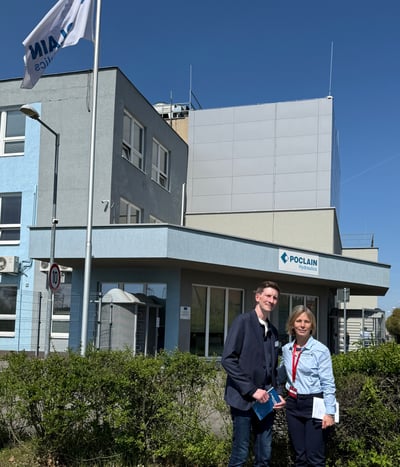
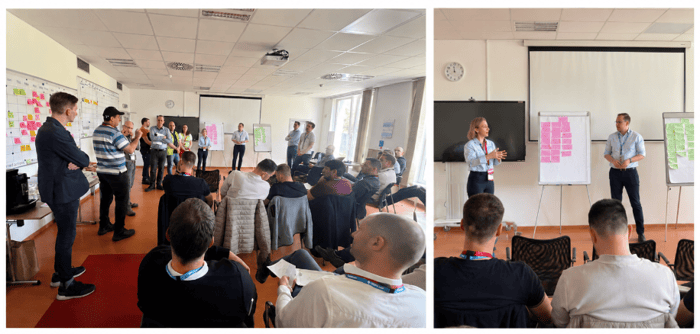
A recent [Gemba walk](https://www.6sigma.us/six-sigma-in-focus/gemba-walk/) at [Poclain Hydraulics s.r.o.](https://poclain.com/) during [Lean Summit Czechoslovakia](https://beexcellent.cz/lean-summit-czechoslovakia/) offers a pragmatic example of how this switch happens in practice.
My colleague Seb Saar and I would like to thank the Poclain Hydraulics s.r.o. team members who guided us during the Gemba walk: Kristyna Safarova, David Cerny, Zuzana Kubesova, Ondrej Osicka, Michal Cermak, and Giovanni Baffoni.
## **The Challenge: Complexity, Variation, and Limited Visibility**
Poclain faced a shift from high-volume, low-mix to high-volume, high-mix production. This introduced more variability, more frequent changeovers, and increasing pressure on both quality and uptime. Quality levels, along with unplanned downtime, were affecting production flow. At this stage, these factors can begin to influence cost, customer satisfaction, and delays.
Without structured data collection and analysis, decisions were largely reactive. Teams relied on experience rather than consistent insight, which made it difficult to address root causes and prevent recurring issues.
**The Solution: Digitalizing Machine Data, Workflows and Problem-Solving**
Poclain’s approach focused on improving how decisions are made by strengthening the role of data across daily operations.
- **Digital data collection at the source:** Operators capture real-time data directly on the shop floor, including machine performance, downtime, quality defects, and cycle times. This helps teams to understand the problem better, and ensures their front-end decisions are based on consistent, trusted inputs.
- **Real-time visibility for faster action:** Machine-level dashboards provide immediate access to OEE, Pareto analysis of failure causes, and alerts for deviations such as micro-stops exceeding defined thresholds. When issues occur, teams can respond quickly, reducing delays and limiting downstream impact.
- **Structured problem solving at every level:** A clear escalation procedure supports consistent problem resolution. Operators address immediate issues, team leaders support root cause identification, and quality teams conduct deeper analysis when needed. This structure reinforces repeatable problem solving and reduces variability in how issues are handled.
- **Standardized, digital work instructions:** Operators access step-by-step instructions through barcode-triggered workflows. This improves changeover speed, reduces errors, and ensures consistent execution, which is especially important in high-mix environments where variation is constant.
## implementation: build a system teams can actually use
During the Gemba walk, the engineering and maintenance manager mentioned that digital transformation delivers value when it accelerates or automates a well-functioning operation. At Poclain, this includes a strong focus on training, visual management of Lean practices, and consistent tracking of production and quality KPIs.
An important shift was moving from isolated problem solving to capturing and reusing knowledge. Root causes, actions, and outcomes are documented and shared, allowing improvements to scale across teams and preventing the same issues from repeating.
This example reinforces a set of practical principles. Digitalization supports better decisions when it is grounded in real operational needs. Real-time data enables faster and more confident action. Standardized problem solving reduces firefighting and improves consistency. Capturing knowledge ensures that improvements are sustained and repeatable. Visibility across teams strengthens alignment and overall performance.
## **How Do You Turn Manufacturing Data into Action?**
Many organizations already collect large amounts of data but struggle to translate it into meaningful action. Progress starts with a structured approach that connects data to decisions.
This includes collecting the right data at the right level, preparing it for analysis, and applying analytics to identify root causes and key drivers. Insights then need to be shared through clear dashboards and embedded into daily workflows so that problems can be solved quickly when they occur.
With the right tools and methodology, teams can move from reactive operations to proactive, data-driven performance management.
## ****
## **Take the Next Step**
If your focus is improving visibility across manufacturing processes, reducing downtime and quality issues, and enabling faster decision-making on the shop floor, the next step is to rethink how data flows through your organization.
Minitab helps connect data collection, preparation, analysis, and visualization into a structured approach that supports better decisions at every level. By making complex data easier to understand and act on, teams can identify bottlenecks, resolve them faster, and demonstrate measurable business impact.
### Explore how Minitab consulting can accelerate your digital manufacturing journey. [](https://blog.minitab.com/hs/cta/wi/redirect?encryptedPayload=AVxigLIYgVkORHK9RAr%2Bz7KM6lt6c6j2hZye94JlbLXpPVwQgQodScjz9D23ig9a2AIf8JTKXwTT%2BUX%2FRUzpYcamoWY1ktsHCxlwqv4SK7fgG%2Fjl2pd%2FeC8lyd1ZnUdHrBIisSRykp6zVj4sKYc%2Byv2Cr4o%2Bjad6d9D%2BkCz2sBWXKx8UfMMdwN%2BrRWFFRfbREKCvHUwtcvP2bTdGXZeCqDExUMcOeaXnYSJsqw%3D%3D&webInteractiveContentId=212480088466&portalId=3447555&hsLang=en)
## You Might Also Like
[How OEE Helps Manufacturers Increase Capacity Without Buying New Equipment](https://blog.minitab.com/en/blog/how-oee-helps-manufacturers-increase-capacity-without-buying-new-equipment?hsLang=en)
[Oee](https://blog.minitab.com/en/blog/tag/oee) | 5 Minute Read
[The Most Valuable Thing That OEE Doesn't Measure](https://blog.minitab.com/en/blog/oee-and-spc-for-maufacturing?hsLang=en)
[Manufacturing](https://blog.minitab.com/en/blog/tag/manufacturing) | 3 Minute Read
[The Hidden Driver of Manufacturing Profitability | Cost of Quality](https://blog.minitab.com/en/blog/cost-of-quality-manufacturing-profitability?hsLang=en)
[Quality](https://blog.minitab.com/en/blog/tag/quality) | 3 Minute Read
---
- [Careers](https://www.minitab.com/en-us/company/careers/)
- [Trust Center](https://www.minitab.com/en-us/trust-center/)
- [Suppliers](https://www.minitab.com/en-us/suppliers/)
- [Site Map](https://www.minitab.com/en-us/site-map/)
- [](https://www.linkedin.com/company/minitab/)
- [](https://www.facebook.com/Minitab/)
- [](https://www.youtube.com/user/MinitabInc)
- [](https://www.instagram.com/minitab/)
---
© 2025 Minitab, LLC. All Rights Reserved.
- [Terms of Use](https://www.minitab.com/en-us/legal/terms-of-use/)
- [Privacy Policy](https://www.minitab.com/en-us/legal/privacy-policy/)
- [Legal](https://www.minitab.com/en-us/legal/)
- Cookies Settings