




Overall Equipment Effectiveness, or OEE, is one of the most widely used metrics in manufacturing. It measures how much planned production time is truly productive and helps reveal losses tied to downtime, slow cycles, and poor quality.
What is OEE and How is OEE calculated?
For most manufacturers, the challenge is not the metric itself. It is the quality of the data behind it.
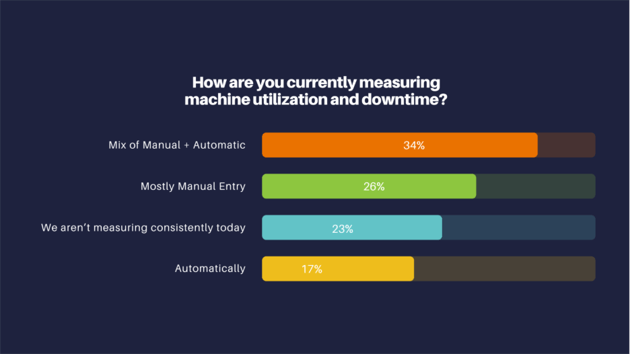
From our recent webinar, only seventeen percent of surveyed webinar attendees are measuring machine utilization and downtime automatically from machine-connected systems.
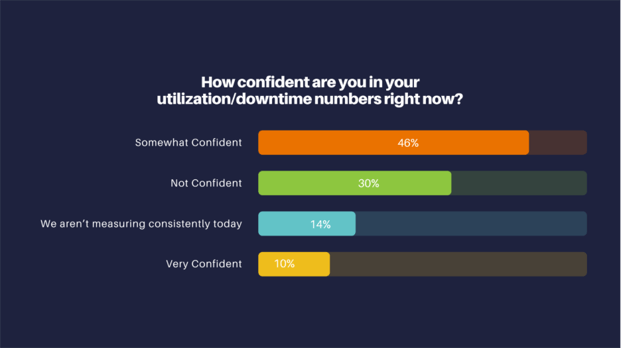
Thirty percent of attendees surveyed say they are not confident in their utilization/downtime metrics. Why? Because OEE is only as reliable as the data used to calculate it. If you’re not collecting data directly from your machines, it’s hard for your entire organization to trust the data.
Josh Davids, Director of Operations for Minitab DataXchange, shared in our recent webinar, how manufacturers can move beyond manual tracking and disconnected systems to achieve reliable, real-time OEE using machine data.
Watch the session on-demand.

Here are the key takeaways:
The Challenge with OEE
Most OEE challenges are not mathematical. They are operational.
Most teams collect data manually, which introduces inconsistencies caused by human error.
Limited real-time visibility causes alerts and action to be delayed, making it harder to act quickly.
Downtime reasons are often defined differently from one machine to another. This makes tracking OEE inconsistent.
These challenges turn dashboards into background noise instead of decision-making insights.
The foundation of reliable OEE is automated, real-time data collection combined with clear rules that match exactly how your manufacturing environment operates.
Automating Data Collection on the Shop Floor
Reliable OEE starts with capturing accurate machine data. Minitab DataXchange connects directly to equipment using standard protocols such as OPC UA, MTConnect, and Modbus TCP, as well as common CNC control integrations. For older or legacy equipment, hardware modules and sensors provide a practical alternative.
The goal is simple: automatically determine whether a machine is running, in planned downtime, or in unplanned downtime. This reduces reliance on manual tracking and creates a consistent baseline for your availability.
Flexibility Across Machines Is Critical
Two shops can run identical machines and define downtime differently. Depending on the shop, answers to the following questions might be different:
- When does setup officially end?
- Is a short automatic tool change considered downtime?
- Should proving out a part count as production or setup?
There is no universal right answer. What matters most is alignment between system logic and operational reality.
DataXchange enables configurable collection rules and user-defined downtime codes so the system reflects exactly how your team works. This flexibility helps ensure accuracy.
Give Your Operators a Voice
Automation does not eliminate the need for human input. In high-mix, low-volume environments especially, operator insight is critical. The operator data Interface allows team members to enter specific downtime reasons that cannot be automatically collected off machinery.
The interface runs on tablets, PCs, or mobile devices and can be positioned directly at the machine or shared across work centers.
This transforms your machine monitoring from a passive monitoring system into a proactive communication system.
Dashboards for Different Levels of Your Organization
Different roles require different levels of detail. DataXchange dashboards are configurable to support:
- Shift-level utilization views for operators
- Hour-by-hour trend charts for supervisors
- High-level quarterly reports delivered to executives
Dashboards update in real time and can rotate on shop floor displays. Scheduled emails deliver reports directly to inboxes, ensuring stakeholders receive relevant insights without adding to their workload.
The result is more visibility and quicker response to issues.
Alerts that Drive Action
In lights-out or unattended environments, notifications are event driven. When a machine stops, a supervisor can receive an alert immediately.
In operator-driven environments, notifications often focus on lack of events. For example, if a machine has been idle too long without a documented reason, the system can prompt the operator to specify why.
This proactive approach shortens response times and reduces lost production.
Improvements in Communication
The value goes beyond reliable metrics around your shop floor's productivity; it also comes from the communication those reliable metrics facilitate across your organization.
When machine data flows automatically, operators can add context, dashboards are visible across the facility, and leadership has access to trusted metrics, the organization begins communicating with a single source of truth.
That cultural shift leads to faster issue resolution, greater accountability, and more informed decisions across your organization.
The Minitab Manufacturing Solution
With the addition of real-time machine monitoring and inspection data collection, Minitab bridges the divide between production and quality.
Production-side machine utilization and downtime insights complement automated measurement data collection. Over time, tighter integration across these systems will help manufacturers move from reactive analysis to more responsive, data-informed operations.
Bridge the data gap in your organization.
