Many Minitab users are highly skilled at identifying root causes and explaining what happened in a process. With the level of data collection, research, and statistical rigor applied every day, it’s surprising how often decisions about what to do next still rely on assumptions.
That gap shows up most clearly in the Improve phase of a Six Sigma project, where uncertainty around future performance can slow progress or lead to costly missteps.
Simul8 Discrete Event Simulation lets you test changes in a safe, digital version of your process before they impact operations. Instead of relying on averages or instinct, you can model real-world variability, constraints, and queues to see how your system actually behaves.
Minitab consultants work with quality engineers, CI leaders, and operations managers to build simulation models, iterate scenarios, and turn data into clear, confident decisions that improve performance. This reflects a core principle of Minitab’s approach: data should move decisions forward, not leave room for guesswork.
See how simulation can strengthen your next Six Sigma project.

Specific Examples of How Minitab Simulation Consulting Can Help
Here are five ways Minitab simulation consulting improves process performance:
1. Identify bottlenecks in production
Perhaps you know that your output is constrained, but you’re not sure where. Before investing in new equipment or experimenting with your layout, Minitab experts can help identify where flow breaks down and where improvements will have the greatest impact.
2. Plan capacity without guesswork
Have you ever asked yourself “how much can we produce?” A simulation consultant can help build a model for different demand scenarios, staffing levels, and machine utilization so you can plan capacity with confidence.
Not sure how much capacity you’re losing to underused machines? See where it’s going.

3. Optimize supply chain networks
Complex supply chains create delays, inefficiencies, and costs. Whether you're addressing disruption or optimizing your existing network, simulation experts can help model warehouse locations, transportation routes, and inventory strategies before changes are made.
4. Enhance workforce and staffing operations
Understaffing impacts throughput and customer experience, while overstaffing increases costs. A simulation consultant can help model optimal staffing levels across shifts, task allocation, and skill levels so resources align with actual demand.
5. Reduce wait times and improve service levels
Are your customers experiencing inconsistent service levels? Are wait times too long? A simulation consultant can map your process, build a simulation model, and test improvements before implementing them.
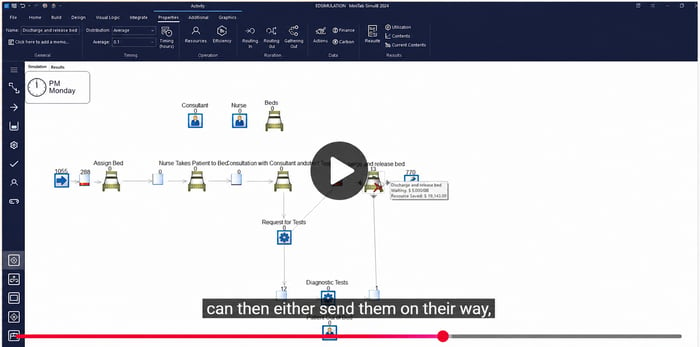
Watch Cheryl Pammer demo how simulation improves process performance
When Should You Use Simulation in a Six Sigma Project?
Simulation is most valuable when you’re moving from analysis to action and need to evaluate potential changes before implementation. It gives CI leaders and quality engineers a way to test improvements, compare scenarios, and reduce risk while accelerating results.
Get expert support for your next simulation project.