




Most manufacturing leaders think of quality as a compliance issue or an operational KPI. But the reality is much bigger: quality is one of the largest and most underutilized levers for improving profitability.
If you’re a quality engineer born in the 1970s or 1980s, you’re probably thinking “no, duh.” If you’re a millennial or Gen Z quality pro you may even be texting something like: #obvy. But here’s the problem: while 75% of C-suite leaders believe their organization has a strong quality culture, less than half of quality professionals agree. So there’s clearly a gap in understanding the value and cost of quality and the potential impact to a company’s bottom line. As Jerry Maguire once said “help me help you” show how important quality is.
Why Quality Is More Than a Compliance Metric
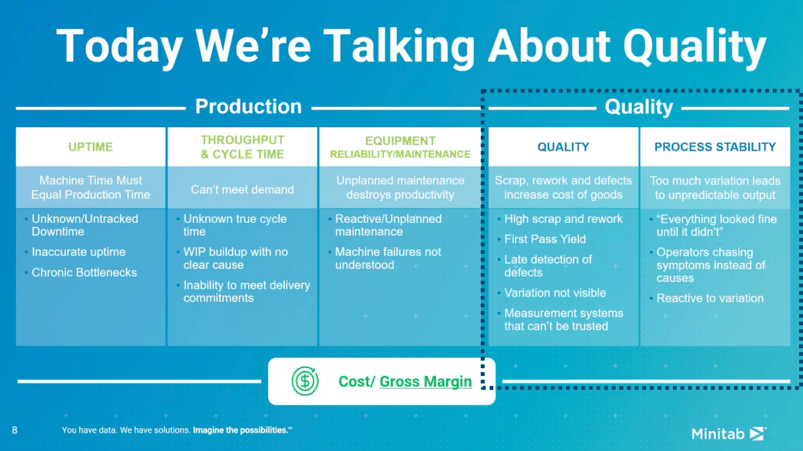
Most leaders understand that poor quality impacts reputation and customer satisfaction, which in turn hurts revenues. They even understand the concept of scrap and defects costing the company money. However, they aren’t really thinking about improving quality as a margin lever. They simply assume that the quality is part of the process – and not an area that can generate a high return on investment.
Quality practitioners are familiar with the Total Cost of Quality, but it often remains hidden in the shadows away from the C-suite. For those who don’t know, the goal of the Total Cost of Quality is to capture the full financial impact of quality across the business:
Cost of Quality = Cost of Conformance + Cost of Non-Conformance
- Conformance (good quality) → Prevention + Appraisal
- Non-conformance (poor quality) → Internal failures + External failures
Want to see how leading manufacturers connect quality improvements directly to financial performance?
Watch my on-demand Statistical CFO session, Why Quality Is Your Biggest Margin Opportunity, to learn how reducing scrap, rework, and process variation can improve margins while strengthening operations.

Start Turning Quality Into a Competitive Advantage
Most organizations underestimate their quality costs. For high performing organizations, Total Cost of Quality may be 1-5%. For average performers 5%-15% and for low performing organizations anywhere from 15% to 40%. For a $500M revenue company, on average, that represents anywhere from $25M to $75M in costs. There’s a lot of margin to gain by cutting that down.
Improving quality should be an area of investment with potential for significant returns. Put simply, the more you spend on prevention, the less you’ll spend on quality failures. So the next time your CFO asks for margin improvement, here’s hoping the quality group gets up and screams “show me the money!” And know that while we at Minitab may not be as cool as Jerry Maguire, as soon as you call and ask for help in improving your quality you’ll get a simple response: “You had me at hello.”